When the Stickers Disagree: Reading Auxiliary Labels Without Guessing

A prescription vial rarely travels alone. Alongside the printed directions — the line your prescriber wrote and the pharmacy transcribed — comes a cluster of smaller stickers, each one a compressed warning: 'Take with food.' 'May cause drowsiness.' 'Avoid prolonged sunlight.' These are auxiliary labels, and they exist for a sound reason: the directions line tells you how much and how often, but it seldom tells you everything that could make a medicine work better or go wrong. The stickers fill in that gap.
They fill it imperfectly, though. Auxiliary labels are not standardized across the United States, they are generated by software and chosen by individual pharmacies, and on occasion two of them can pull in opposite directions. Knowing what they can and cannot tell you is part of taking a medicine safely.
What the Auxiliary Label Is — and Is Not
The legal direction for a prescription is the sig — the instruction line, such as 'take one tablet by mouth twice daily.' That line, together with the patient name, drug name, strength, quantity, and fill date, is what state boards of pharmacy regulate. Auxiliary labels are supplementary. They carry no independent legal weight, and no federal agency approves their wording.
That matters practically. A pharmacist may add a sticker because a drug database flags a common side effect, because a state rule requires a caution for a controlled substance, or because a particular patient mentioned an upset stomach last month. One pharmacy's 'Take with food' may appear as a pictogram of a fork and plate elsewhere; another may omit it entirely.
A Short Field Guide to Familiar Warnings
'Take with food' is among the most common and the vaguest. For some drugs it means a full meal reduces stomach irritation; for others it means food improves absorption, and a handful of crackers may not be enough. Ask what counts.
'Take on an empty stomach' usually means one hour before or two hours after eating, but the interval varies by drug and by reference. If you eat on a different schedule, say so.
'May cause drowsiness' is a caution, not a prediction. It does not tell you whether you personally will feel sleepy, and it does not settle the question of driving. It does pair meaningfully with alcohol, which generally amplifies sedation.
'Avoid prolonged sunlight' or 'may increase sensitivity to sun' applies to antibiotics such as tetracyclines and fluoroquinolones, some diuretics, and certain acne treatments. Window light through a car is still sunlight; a broad-spectrum sunscreen and covering clothing are the usual response.
'Do not drink alcoholic beverages' appears on metronidazole, some sedatives, and many pain medicines. Read it literally unless the pharmacist tells you otherwise.
'Shake well' and 'refrigerate — do not freeze' are storage directions that protect the dose itself. An oral suspension that separates will not deliver an even dose; a frozen liquid may be ruined.
Where the Stickers Stop Being Helpful
Because auxiliary labels are not standardized, they can be incomplete. A sticker may warn of drowsiness but say nothing about dizziness on standing. It may caution against sunlight but not mention that a second prescription in the same bag carries the same warning.
They can also be generic. A drowsiness sticker placed on a bedtime medicine tells you little you did not already know, while a patient who drives to work after a morning dose may need a more specific conversation. And they can age badly: a pharmacy switching software vendors may change its label set overnight, so the sticker on your refill may not match the one on the bottle in your cabinet.
When Two Stickers Seem to Conflict
Two instructions that look contradictory are worth a phone call, not a guess. The common examples:
- 'Take with food' on one line and 'take on an empty stomach' on another — usually a sign that two prescriptions in the same bag have different requirements, and the stickers were applied to the wrong vials or read as a set.
- 'May cause drowsiness' alongside 'take in the morning' — often fine, but worth confirming whether the sedating effect is expected to fade.
- 'Avoid sunlight' plus 'take at bedtime' — generally compatible, since the dose is taken after dark, but ask whether the sensitivity lasts through the next day.
Questions Worth Asking at the Window
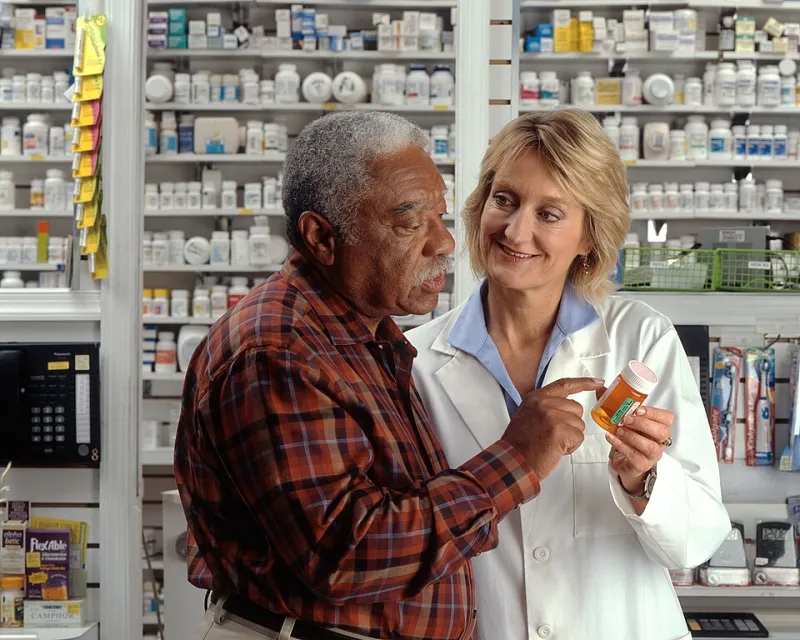
The pharmacy counter is the right place to resolve ambiguity, and a few specific questions get better answers than a general 'Is this okay?'
- Does 'with food' mean a meal, or will a snack do?
- How long before or after eating should I take this?
- Is the drowsiness warning about driving, operating machinery, or both?
- Does 'avoid sunlight' include the walk from my car to the office?
- If I take this at night, do I still need to avoid sun the next day?
- Can this be taken with the other medicines and supplements I use?
If a Sticker Is Torn, Faded, or Missing
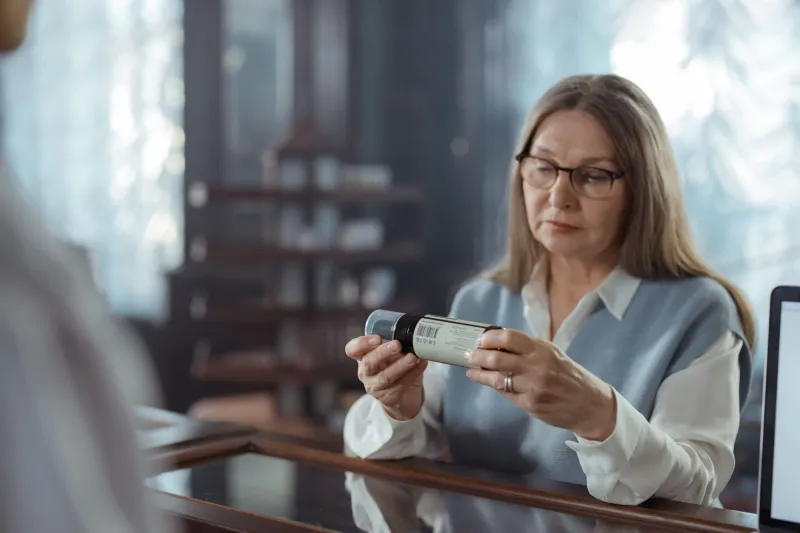
Adhesive fails, and printers smudge. If a warning has become unreadable, ask for a replacement label or a printed patient information sheet rather than relying on memory. The same applies when a refill arrives with a sticker the previous bottle did not have — that is a change worth understanding, not ignoring.
Auxiliary labels are a shorthand, written by a pharmacy for a broad audience, and they do a great deal of quiet work. They are simply not a substitute for the directions line, the pharmacist's explanation, or your own questions. Read them closely, and when they seem to disagree, treat the counter as the place where the ambiguity ends.