A Spoonful Is Not a Dose: Getting Liquid Medicines Right at Home
A parent pours amoxicillin into a teaspoon, tilts it toward a reluctant four-year-old, and considers the job done. What that teaspoon delivered could plausibly have been anywhere from 3 to 7 milliliters. For a drug dosed at 400 milligrams per 5 milliliters, that is not a small rounding error — it is a swing of more than 300 milligrams between two doses from the same bottle. Liquid medicines ask more of the person administering them than tablets do, and the label instructions that look like household boilerplate are, in fact, part of the formulation.
Why the Bottle Separates in the First Place
Most prescription liquids dispensed in the United States are suspensions, not true solutions. The active ingredient exists as fine particles dispersed throughout a liquid vehicle rather than dissolved into it. That arrangement is chemically useful — many antibiotics are unstable in solution and last longer as a suspension — but it is physically temporary. Gravity pulls the particles downward, and over hours to days they settle. Some settle loosely and redisperse with a gentle swirl. Others compact into a dense layer at the bottom of the bottle, a phenomenon pharmacists call caking, which resists even vigorous shaking.
When a patient draws a dose from a settled bottle without mixing, the early doses are dilute and the final doses are concentrated. The total drug in the bottle has not changed, but its distribution has. A ten-day course of a pediatric antibiotic can begin under-dosed and end over-dosed, which is one reason a course that seems to be failing may simply have been administered unevenly. A properly shaken bottle produces a uniform dispersion, which is what the manufacturer tested and what the prescriber assumed.
"Shake well" therefore is not a suggestion about texture or taste. It is the instruction that restores the product to the state in which its concentration was validated.
Reading the Shake Instruction Correctly
Labels differ more than most patients expect. "Shake well before each use" means precisely that — before every dose, not once at the start of the week. "Shake well before use" on a reconstituted antibiotic may refer to the initial mixing at the pharmacy and to each subsequent dose. Some liquids, particularly solutions and elixirs, carry no shake instruction at all, and shaking them accomplishes nothing except introducing bubbles that make measurement less accurate.
A practical routine: hold the bottle at eye level, invert it and return it upright several times in a smooth rocking motion, then look for a uniform color and texture with no visible sediment at the base. Shaking is more effective than swirling for products prone to settling. If a hardened layer will not break up after a reasonable effort, do not improvise — contact the dispensing pharmacy. A caked suspension may not be recoverable, and the right answer may be a replacement bottle rather than a longer shake.
The Teaspoon Problem
Household spoons are the single most common source of dosing error in home liquid medicine, and the reason is simple arithmetic. A "teaspoon" in kitchen terms is a piece of cutlery, and its actual volume varies widely — studies of household flatware have found capacities from roughly 3 to 7 milliliters in ordinary teaspoons, with larger spoons running higher still. Because a standard teaspoon is defined as 5 milliliters, the potential deviation is substantial in percentage terms, and it grows larger as the prescribed dose shrinks. A 2.5-milliliter infant dose measured in an oversized spoon could easily double.
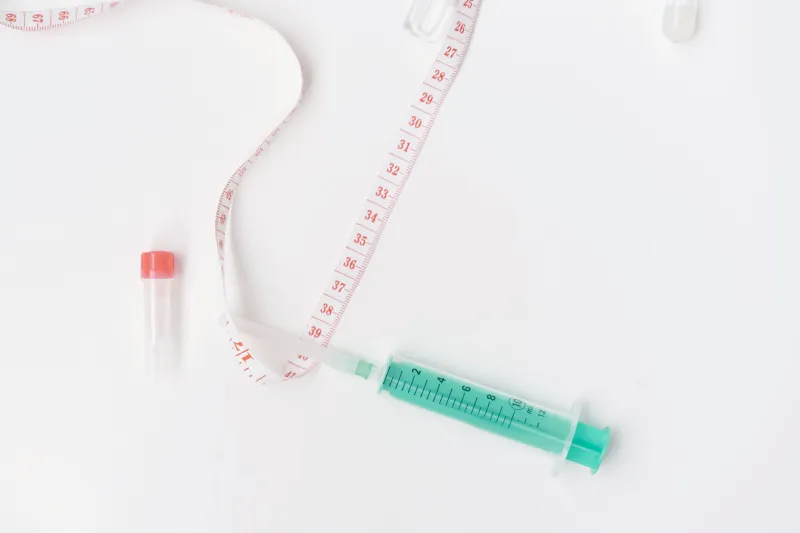
Dosing cups that ship with over-the-counter products are better than spoons but are still imprecise when held at an angle, read with a meniscus, or filled over a sink. The most accurate tool available to a patient is an oral syringe, calibrated in milliliters, sized to the prescribed dose. Pharmacies supply them on request and typically at no charge; a family that administers liquid medicine regularly should keep one per patient and per product, labeled so that syringes are not swapped between bottles with different concentrations.
Useful habits for syringes and cups alike:
- Measure at eye level on a flat surface, not while holding the device aloft.
- Read the graduated markings at the bottom of the curved liquid surface, not the rim.
- Rinse the syringe with warm water after each use and let it air dry, since residue can obstruct the tip and skew the next draw.
- Never use a syringe from one product to measure another without washing it first.
- Ask the pharmacist to mark the prescribed dose on the syringe with a piece of tape or a permanent marker.
Reconstituted Antibiotics and the Refrigeration Question
Many pediatric antibiotic suspensions arrive as a powder that the pharmacy mixes with purified water at the point of dispensing. The resulting product has a short beyond-use date, commonly ten to fourteen days, and a storage instruction that is product-specific. Some require refrigeration; others are stable at room temperature but must be discarded on schedule regardless. Refrigerating a product that does not require it is usually harmless, but leaving a "refrigerate" product on the counter for a day is not.
Two points deserve emphasis. First, the discard date on the label is not optional guidance — it reflects the point at which the manufacturer can no longer vouch for potency or microbial safety. Second, a partially used bottle should not be saved for a future illness, both because it will have expired and because the concentration may no longer be trustworthy. Patients who are unsure whether a particular bottle belongs in the refrigerator should call the pharmacy rather than guess; the answer takes seconds and the label does not always make it obvious.
When a Dose Goes Wrong
Two scenarios come up often, and they call for different responses.
If a dose is spilled, the correct approach is to estimate how much was actually lost rather than to automatically repeat the full amount. A dose that is entirely on the floor warrants replacement; a dose where half the syringe was delivered generally does not. The pharmacist can advise on whether to substitute a partial dose or simply wait for the next scheduled one, and the answer depends on the drug's therapeutic window.
If a child spits up or vomits shortly after a dose, the calculation is murkier. Guidance varies by medication and by how much time has passed; some drugs are well absorbed within fifteen to thirty minutes, while others are not. A single call to the pharmacy — with the drug name, dose, and elapsed time in hand — will produce a specific answer. Doubling up without that conversation risks an overdose, and skipping the dose entirely risks an under-treated infection.
Liquid medicine rewards attention to a few small details: mixing the bottle, measuring in milliliters with a device designed for the purpose, and respecting the storage instructions printed on the label. None of these steps takes more than a few seconds, and together they are the difference between the dose that was prescribed and something close to it.